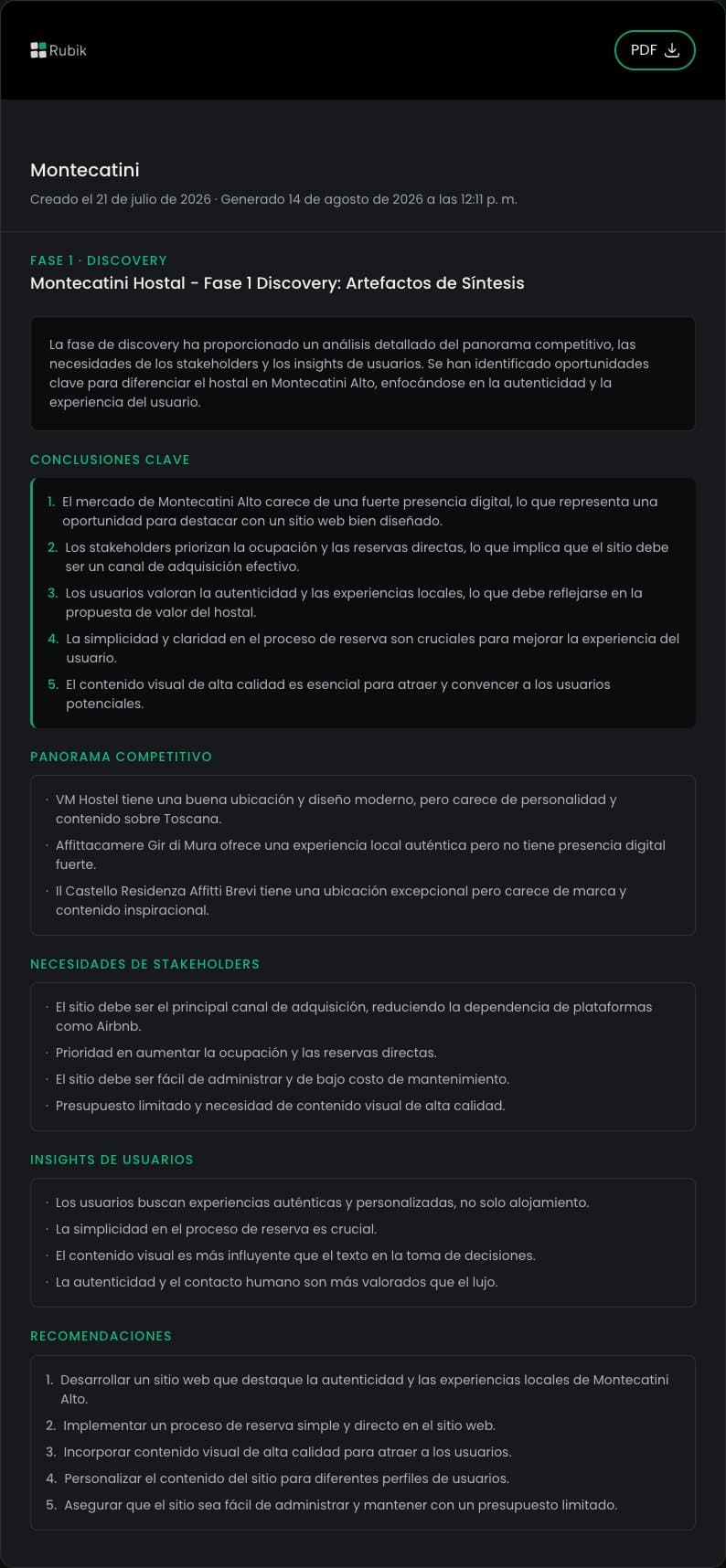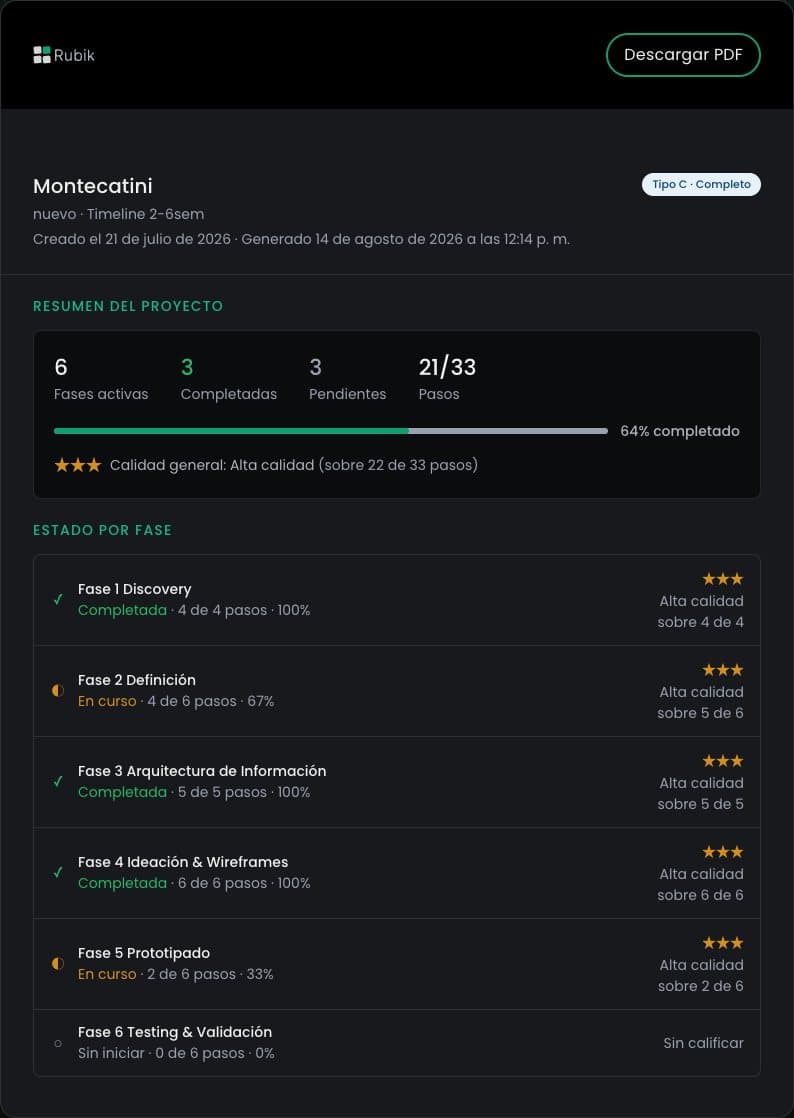







UX designer
Stop starting from scratch on every project. Research, personas, architecture, wireframes, prototype and testing — with the quality criteria defined at each step.
Rubik guides you through every design phase and validates your process against Nielsen Norman Group, IxDF, WCAG, Stanford d.school, Material Design and many more.
0
Phases to cover any type of project.
0
Structured steps, all connected.
0
Design principles with verifiable sources.
0
Hallucinations or unjustified decisions.
Step 36 of 36
100%
Test your design
Paste the address of any page. We'll run a limited test, checking only against the knowledge base's interface principles and WCAG 2.1, and return every finding with the rule it breaks, its author and its source. No account.
Seeing is believing
Two real examples, with the sources Rubik cites.
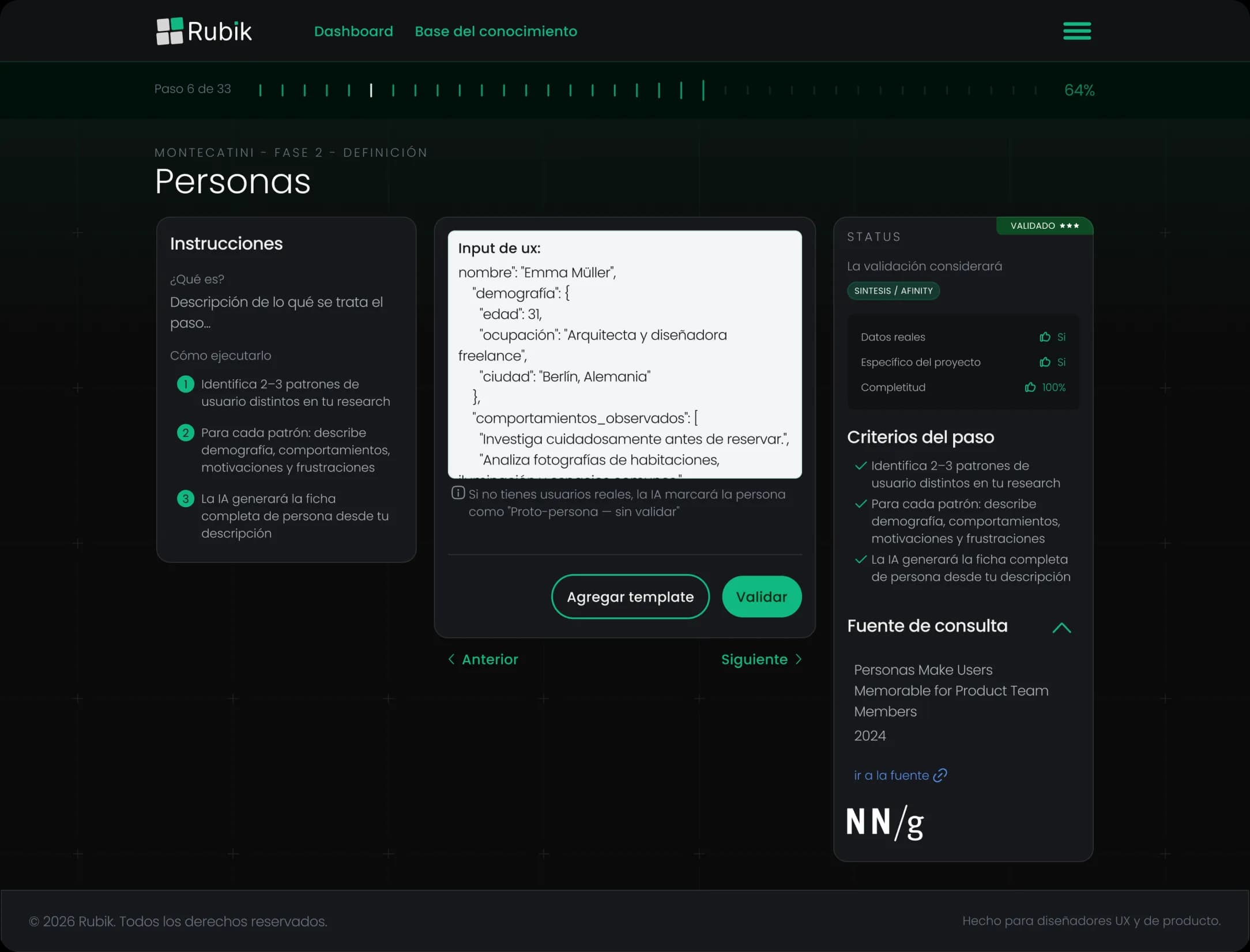
UX input:
If you don't have real users, the AI will mark the persona as "Proto-persona — not validated".
Status
The validation will consider
Real data
YesProject-specific
YesCompleteness
100%Step criteria
Identify 2–3 distinct user patterns in your research
For each pattern: describe demographics, behaviors, motivations and frustrations
Reference source
Jakob Nielsen
Nielsen Norman Group
2024
Usability heuristics
Visibility of system status
go to the source
The problem
Some good designers produce inconsistent work not for lack of talent, but for lack of structure.
Without a repeatable process, quality varies from one project to the next and is almost impossible to defend.
Is a sitemap with 9 items per level correct? Without a reference, there's no way to know.
Generic tools cite principles that don't exist or distort the original source.
Without an explicit criterion, the quality of a deliverable ends up being an opinion.
Who it's for
Rubik works out the process for your project: from a 3-day sprint to a complete 4-month process.
Stop starting from scratch on every project. Research, personas, architecture, wireframes, prototype and testing — with the quality criteria defined at each step.

Connect design with business: JTBD, problem statement, design KPIs, prioritization of findings and developer handoff. The language your PM and your development team already speak.

PDF reports by phase or for the whole project, with every source cited. Stop selling confidence: deliver proof.
How it works
Each step tells you what to do, the AI validates what you deliver and Rubik rates it against real sources.
Select whether you'll run a complete project or a single-phase one.
Partial process
Work on just one specific phase — useful when you've already advanced part of the process in another tool.
Complete process
UX design process to run in 6 phases, from discovery to testing. Ideal for new products or complete redesigns.
Recommended for most projects
The 6 main phases
Six phases, thirty-six steps. Each with its template, its quality criteria and its reference principles.
Phase 1
User research, competitive analysis and heuristic evaluation to understand the problem before designing.
Phase 2
Personas, journey maps, JTBD, problem statement and design KPIs to define the right problem.
Phase 3
Content inventory, sitemap, user flows and content matrix to structure the solution.
Phase 4
Structured ideation, design principles and Lo-fi and Mid-fi wireframes to generate and validate solutions.
Phase 5
Design tokens, components, Hi-fi UI, WCAG accessibility and complete developer handoff.
Phase 6
Testing plan, results synthesis, prioritization of findings and validation against the defined KPIs.
The differentiator
The difference between Rubik and any other AI tool is simple: Rubik never cites a principle that doesn't exist.
Quality system
Every deliverable gets a quality level based on the step's criteria and the knowledge base principles.
Critical problems or incomplete deliverable. It must be fixed.
Blocks progress on the step
Meets the minimum. Important improvements are recommended.
Allows marking as completed
Good work. Some optional improvements available.
Allows marking as completed
Complete, specific and well-documented deliverable.
Professional-level work
Frequently asked questions
Create your free account and validate your first deliverable today.
Create your project for free!Free · No credit card